
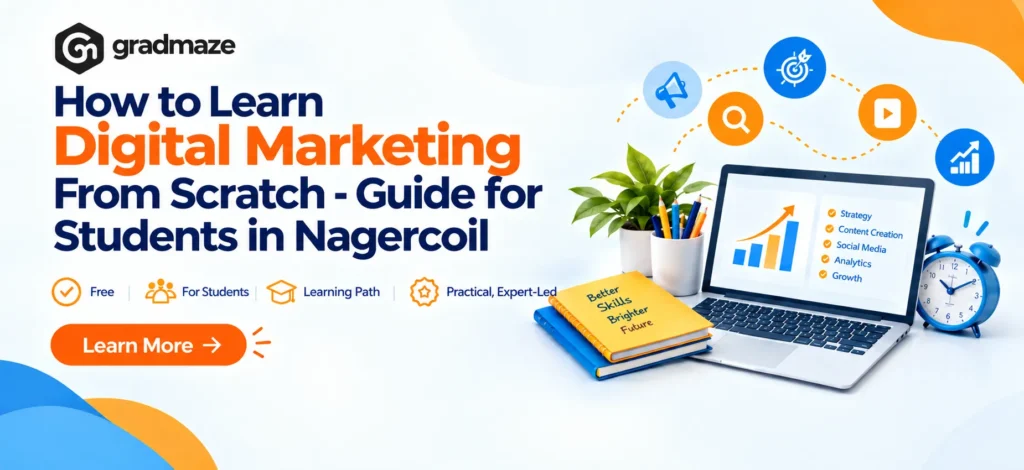
| Learning digital marketing from scratch takes anywhere from 8 weeks to 6 months depending entirely on how you learn structured, mentor-led, project-based training gets beginners to a job-ready level in 8–12 weeks, while self-taught learning through scattered YouTube videos typically takes 4–6 months and still leaves gaps employers notice at interview stage. The fastest path covers strategy, SEO, content, social media, Google Ads/Meta Ads, and analytics in that order, built around real campaigns rather than just theory, and freshers in India who complete this path typically start between ₹2.5–4.5 LPA, with strong portfolios pushing offers higher. This guide breaks down exactly what to learn, in what order, and how long each stage realistically takes so you can plan your path with confidence instead of guesswork. |
What Does “Learning Digital Marketing From Scratch” Actually Mean?
Digital marketing isn’t one skill; it’s a cluster of related skills that work together. When people ask how to learn digital marketing from scratch, they usually mean building competence across five core areas:
- SEO (Search Engine Optimization): getting websites to rank on Google
- Social Media Marketing: building and growing brand presence on Instagram, LinkedIn, and Facebook
- Paid Advertising: running Google Ads and Meta Ads campaigns
- Content Marketing: writing content that attracts and converts an audience
- Analytics: reading data (Google Analytics, ad dashboards) to know what’s actually working
A true beginner doesn’t need to master all five before applying for jobs. Most entry-level roles hire for depth in one or two areas plus working familiarity with the rest. The mistake most self-taught learners make is trying to learn everything at once, in no particular order, from a dozen different sources, which is precisely what stretches “3 months” into “8 months.”
How Long Does It Take to Learn Digital Marketing?
There’s no single number, but here’s a realistic breakdown based on learning method:
Self-taught (free YouTube videos, blogs, scattered courses) – 4–6 months to reach a basic working level, often longer because there’s no structured order and no one checking your work. Many self-taught learners plateau because they never run a real campaign; they only watch others run one.
Online self-paced certification courses (Google, HubSpot, Meta Blueprint) – 2–4 months to complete the certifications themselves, but these teach concepts in isolation. You’ll understand what SEO is without ever having improved a real website’s ranking.
Structured, mentor-led bootcamp with live projects – 8–12 weeks to go from zero to job-ready, because the curriculum is sequenced, the projects are real, and a mentor corrects your mistakes in real time instead of you discovering them at your first job.
The difference isn’t really about how much content there is to learn; digital marketing fundamentals aren’t infinite. It’s about structure, sequencing, and whether you’re doing the work yourself or just consuming information about the work.
How to Get Started: A Step-by-Step Learning Path
If you’re starting from zero, follow this order rather than jumping between random topics:
- Start with the fundamentals of marketing strategy – Understand target audiences, customer journeys, and how a marketing funnel works before touching any tool.
- Learn SEO basics first – It underpins almost everything else content, social, and even paid ads perform better when you understand search intent.
- Move to content marketing – Learn to write for blogs, ads, and social captions with a clear goal in mind (traffic, leads, or sales).
- Pick up social media marketing – Learn platform-specific strategy what works on Instagram is different from what works on LinkedIn.
- Learn paid advertising (Google Ads and Meta Ads) – This is where campaigns get measurable, and where most entry-level hiring managers want to see hands-on experience.
- Finish with analytics – Learn to read Google Analytics and ad dashboards to tie everything back to real results.
Running through this sequence on your own is possible, but it’s slow without feedback. This is precisely why GradMaze’s digital marketing course is built around this order, with a mentor checking your campaigns at every stage instead of leaving you to guess whether what you built actually works.
The Gradmaze Advantage: Learning Digital Marketing in Nagercoil
Most digital marketing “courses” online are pre-recorded video libraries you watch, you move on, and no one checks whether you actually understood it. At GradMaze in Nagercoil, the approach is different. Our digital marketing program runs as a 9-week intensive bootcamp followed by a 2-week career sprint focused on resume building, interview preparation, and portfolio polish.
so working professionals in Kanyakumari, Marthandam, and Thuckalay can train without quitting their current job. The learning is cohort-based and project-driven; you build real campaigns, get mentor feedback, and leave with a portfolio, not just a certificate. That’s the structural difference between a 6-month solo struggle and an 8–12 week guided sprint to job-readiness.
We don’t promise guaranteed placements; nobody honestly can. What we do offer is access to a 50+ employer network and a selective placement track for students who put in the work during the bootcamp and Career Sprint.
Common Mistakes That Slow Down Learning
- Learning tools before strategy – Knowing how to click through Google Ads’ interface means nothing if you don’t understand who you’re targeting and why.
- Skipping real campaigns – Watching a tutorial on running Facebook ads isn’t the same as running one, tracking its results, and fixing what didn’t work.
- Chasing every new certification – Certificates from Google or HubSpot are useful additions to a resume, but stacking five of them without practical experience won’t get you hired on their own.
- Learning in isolation – Without a mentor or peer group, it’s hard to know if your work is actually good or just “done.”
- No portfolio – Employers hiring freshers want to see 2–3 real projects: a mock campaign, an SEO audit, an ad you actually ran more than they want to see a stack of certificates.
Conclusion
Learning digital marketing from scratch doesn’t have to take half a year of scattered videos and guesswork. With the right sequence strategy that includes SEO, content creation, social media, paid ads, and analytics, along with real feedback on actual campaigns, most beginners can become job-ready in 8–12 weeks. If you’re in Nagercoil, Kanyakumari, or anywhere in South Tamil Nadu and ready to stop researching and start building, apply for the next cohort at GradMaze and turn this into a career, not just a curiosity.
Frequently Asked Questions
1.How long does it take to learn digital marketing from scratch?
With a structured, mentor-led program, most beginners reach a job-ready level in 8–12 weeks. Self-taught learners using free resources typically take 4–6 months, partly because there’s no set sequence and no one reviewing their work along the way.
2.Can I learn digital marketing without a technical or marketing background?
Yes. Digital marketing is one of the most accessible tech-adjacent careers for beginners because it doesn’t require coding or a specific degree. At GradMaze in Nagercoil, students join from commerce, arts, science, and engineering backgrounds join and learn the same structured curriculum from zero.
3.What is the salary for a digital marketing fresher in India?
Fresher salaries in India typically range from ₹2.5 LPA to ₹4.5 LPA, with candidates who have strong project portfolios or specialized skills in performance marketing sometimes starting higher. Salaries grow quickly with 1–2 years of hands-on campaign experience.
4.Should I learn digital marketing through free YouTube videos or a paid course?
Free content is useful for exploring whether digital marketing interests you, but it rarely provides structured sequencing, real campaign practice, or mentor feedback. A paid, project-based program like GradMaze’s bootcamp compresses months of scattered self-study into 9 focused weeks with actual results to show employers.
5.Is digital marketing a good career choice for freshers in Nagercoil and Kanyakumari?
Yes. Digital marketing is remote-friendly and in demand across e-commerce, SaaS, and local businesses expanding online, which means students in Nagercoil and Kanyakumari can build careers without relocating to major metros. GradMaze’s employer network includes companies actively hiring digital marketing freshers from South Tamil Nadu.
6.Do I need a laptop or specific software to learn digital marketing?
A basic laptop with a stable internet connection is enough to start. Most tools used in digital marketing Google Analytics, Meta Ads Manager, Google Ads, Canva, and SEO tools are cloud-based and either free or offer free trial tiers, so there’s no expensive software to buy before you begin learning.
7.Which digital marketing skill should I learn first as a complete beginner?
Start with SEO fundamentals and basic marketing strategy before moving into content or paid ads. Understanding how search engines work and how customers move through a buying journey makes every other skill social media, ads, and analytics easier to learn and apply correctly.
8.Is digital marketing a better career option than a traditional job for freshers?
Digital marketing typically pays a starting premium over traditional entry-level roles in finance or operations, and it offers remote work flexibility that most traditional fresher jobs don’t. That said, it rewards continuous learning, since tools, platforms, and algorithms change often, so it suits people comfortable with staying updated.
9.How much does it cost to learn digital marketing in India?
Costs vary widely free YouTube content costs nothing but takes longer and lacks feedback, while individual paid certifications (Google, HubSpot, Meta) usually cost under ₹5,000 each. Structured bootcamps with live mentorship and placement support are a bigger investment but compress the learning timeline significantly and add real campaign experience to your resume.
10.Can I switch to digital marketing from a non-marketing degree like engineering or commerce?
Yes, and it’s extremely common. Digital marketing hiring is skills-first rather than degree-first, so engineering, commerce, arts, and science graduates all join GradMaze’s Nagercoil bootcamp and complete the same project-based curriculum regardless of their academic background.