
Quick Summary:
- No IT Background Required – Non-IT students can learn Python full stack with structured guidance, as companies now focus more on skills than degrees.
- Beginner-Friendly Learning Path – Starts with HTML, CSS, and JavaScript, followed by Python, Django, databases, APIs, and deployment in a step-by-step roadmap
- High-Demand Career in India – Python full stack developers are among the most in-demand roles in 2026 with strong hiring across cities and startups.
- Core Skills Make You Job-Ready – Key skills include Python, Django, databases, REST APIs, Git, and deployment along with problem-solving and communication.
- Strong Salary Growth Potential – Freshers can earn ₹3–6 LPA, with rapid growth up to ₹10–18 LPA within a few years of experience.
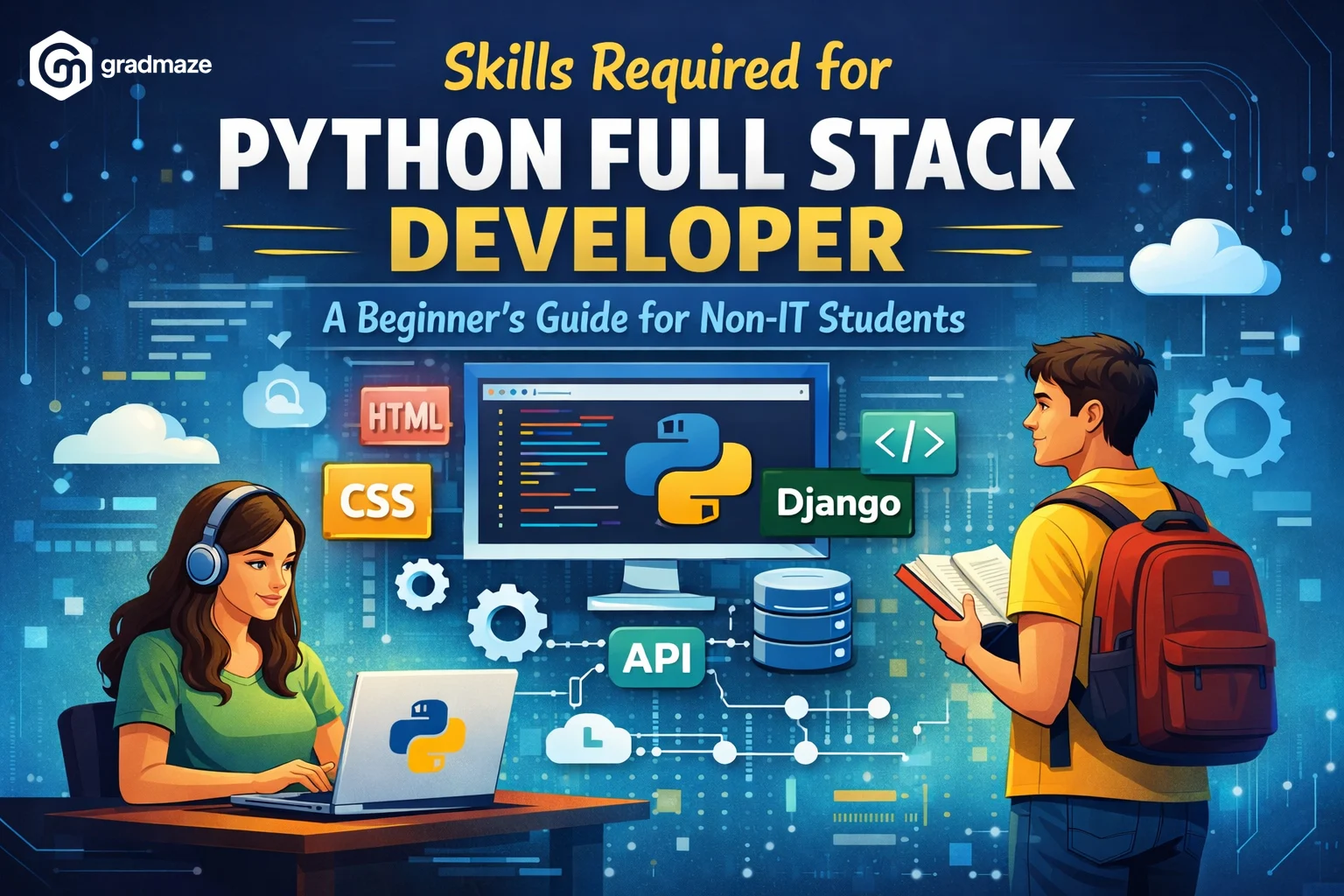
In this blog, we are going to cover everything a non-IT student needs to know before stepping into the world of Python full stack development what the role actually means, which technical and non-technical skills you need to build, how the learning journey looks in 2026, and why this career path is one of the smartest moves you can make right now in India’s job market. Whether you have a commerce background, arts degree, or any non-technical qualification, this guide is written just for you, simple, practical, and straight to the point.
Why Non-IT Students Are Choosing Python Full Stack Development in 2026
Let us be honest. The IT industry in India is no longer just for engineering graduates. Companies across Chennai, Bangalore, Hyderabad, and even tier-2 cities like Nagercoil are actively hiring candidates who can build web applications regardless of their educational background.
Python has become the go-to programming language for beginners because it reads almost like plain English. Unlike Java or C++, Python does not scare people away with complicated syntax. And full stack development? It simply means you can build both what the user sees (front end) and what runs behind the scenes (back end). Put them together and you have one of the most in-demand job profiles of 2026.
The best part is you do not need a BTech degree to get here. What you need is the right skill set and the right guidance.
Core Technical Skills You Need to Learn
This is the heart of this entire blog. If you are a non-IT student seriously considering a career in development, understanding these skills clearly what they are, why they matter, and how long they take will help you plan your learning journey with confidence. Let us go through each one, step by step.
1. HTML, CSS & Basic JavaScript – The Foundation Every Developer Starts With
Before you touch Python, you need to understand how a webpage is actually built. HTML (HyperText Markup Language) gives the page its structure headings, paragraphs, buttons, images. CSS (Cascading Style Sheets) controls how everything looks: the colours, fonts, spacing, and layout. JavaScript brings the page to life dropdown menus, pop-ups, form validations, and animations.
Think of it like constructing a house. HTML is the bricks and walls, CSS is the paint and interior design, and JavaScript is the electricity and plumbing that makes things functional.
For a non-IT student, this phase usually takes 3 to 4 weeks with consistent daily practice of 2 to 3 hours. You do not need to master JavaScript at this stage, just the basics are enough. These three technologies are the entry point of every python full stack course for beginners, and skipping them is not an option because everything else builds on top of this layer.
A practical tip: do not just read about HTML and CSS. Open a code editor like VS Code, build a simple personal profile page, and see how your changes affect what you see on screen. That hands-on experience is what makes the learning stick.
2. Python Programming – The Language That Makes Everything Click
This is where things truly get exciting for beginners. Python is designed to be readable. The code looks almost like written English sentences, which is why non-IT students pick it up far faster than they expect.
You will begin with the absolute basics variables, data types, if-else conditions, loops, and functions. Once you are comfortable there, you move into object-oriented programming (OOP), which teaches you how to organise code into reusable blocks called classes and objects. This concept is used everywhere in real-world development.
What makes Python a brilliant choice in 2026 is its versatility. The same language you learn for web development is also used in data science, machine learning, AI automation, and scripting. So when you invest time in Python, you are not limiting yourself to one path, you are opening multiple doors at the same time. Give yourself 5 to 6 weeks on Python fundamentals before moving forward, and spend that time building small programs like a calculator, a to-do list, or a quiz game.
3. Django or Flask – Where Python Meets the Web
Once you are comfortable with Python, the next step is learning a web framework and this is where you start building actual websites. A framework is essentially a ready-made toolkit that handles the repetitive parts of web development so you can focus on building features.
Django is the most popular and widely taught framework for full stack development in India. It follows a clean, organised structure called MVT (Model-View-Template) and comes with powerful built-in features: user login and registration, an admin panel, form handling, database connection, and security features. Basically, Django gives you a solid starting point so you are not building everything from scratch.
Flask is a lighter alternative. It gives you more control and flexibility but requires you to set up more things manually. It is better suited for smaller applications or when you want to understand how each piece connects. Most structured courses begin with Django because that is what most companies use in production. Expect to spend 4 to 6 weeks getting comfortable with Django basics before you start feeling confident building real pages.
4. Databases – MySQL, PostgreSQL, and Understanding ORM
Every web application you have ever used stores data somewhere your username, your purchase history, your settings. That somewhere is a database, and understanding databases is a non-negotiable skill for any full stack developer.
MySQL is the most commonly taught relational database for beginners. You will learn how to create tables, insert data, retrieve it using SQL queries, update records, and delete them. These are called CRUD operations (Create, Read, Update, Delete) and they are the backbone of almost every application.
PostgreSQL is another powerful database that is widely used in production-level applications, especially startups and companies that deal with complex data. You should at least know the basics of how it differs from MySQL.
Inside Django, you will also work with ORM Object Relational Mapping. This is a feature that lets you interact with your database using Python code instead of writing raw SQL queries. For example, instead of writing SELECT * FROM users WHERE id = 1, you simply write User.objects.get(id=1) in Python. It makes database interaction cleaner, faster, and much easier to manage, especially for beginners.
5. REST APIs – The Skill That Makes You Industry-Ready
This is the skill that genuinely separates a beginner developer from a job-ready one. REST APIs (Representational State Transfer Application Programming Interfaces) are the way different parts of a web application or even different applications communicate with each other.
Imagine you are using a food delivery app. When you place an order, the front end (what you see on your phone) sends a request to the back end (the server), which processes it and returns a response. That entire conversation happens through APIs.
In Django, you will use Django REST Framework (DRF) to build these APIs. You will learn how to create endpoints, handle GET and POST requests, send and receive JSON data, and manage authentication. Once you understand REST APIs, you can connect your Django back end to any front end whether it is a React app, a mobile app, or a third-party tool.
In 2026, nearly every company building modern web products relies on API-first architecture. If you understand how APIs work, you immediately become more valuable as a developer.
6. Version Control with Git and GitHub – How Real Teams Work
Imagine writing 500 lines of code, making a change that breaks everything, and having no way to go back to the version that worked. That is the nightmare Git solves.
Git is a version control system that tracks every change you make to your code. GitHub is the online platform where you store, share, and collaborate on that code. Every IT company from a 5-person startup to a multinational corporation uses Git in their daily workflow.
You will learn commands like git init to start tracking a project, git add and git commit to save changes, git push to upload your work to GitHub, and git pull to get the latest updates from your team. You will also learn how to work with branches creating separate versions of your code to work on new features without disturbing the main working version.
Not knowing Git as a developer in 2026 is like not knowing how to use email in an office. It is that fundamental. The good news is, the core Git concepts can be picked up in a week with daily practice.
7. Deployment – Taking Your App from Your Laptop to the Internet
Building a project on your local machine is satisfying, but putting it live on the internet is where the real achievement lies. Deployment is the process of making your application accessible to anyone with a browser.
You will learn to deploy Django applications on platforms like Render.com or Railway (both beginner-friendly and free to start), and get introduced to the basics of AWS (Amazon Web Services) , the cloud platform used by the majority of real-world applications. You will also understand environment variables, how to manage secret keys securely, and how to connect your live app to a production database.
In 2026, many job descriptions also mention basic familiarity with Docker, a tool that packages your application and all its dependencies into a container so it runs consistently across different machines. You do not need to be a Docker expert as a fresher, but knowing what it is and how to run a basic container puts you ahead of many other candidates.
Having even one deployed project a link you can share with anyone in the world is one of the strongest things you can show during a job interview.
Non-Technical Skills That Matter Just as Much
1. Problem-Solving Mindset
Development is 20% writing code and 80% figuring out why the code is not working. A strong logical thinking ability is what separates good developers from great ones. You develop this through practice not through memorization.
2. Communication and Teamwork
Most development happens in teams. You will work with designers, testers, project managers, and other developers. Being able to explain a technical problem in simple language is a highly valued skill, especially for freshers stepping into their first role.
3. Consistency and Self-Learning
The tech world changes fast. A skill that was trending six months ago might already be outdated. Developers who stay updated by reading documentation, following GitHub projects, or taking short courses are always ahead of the curve.
What Does the Learning Journey Actually Look Like?
For a non-IT student starting from scratch, a well-structured python full stack course for beginners typically covers:
- Month 1: HTML, CSS, JavaScript basics
- Month 2: Python fundamentals and OOP
- Month 3: Django framework and database integration
- Month 4: REST APIs, Git, and deployment
- Month 5 & 6: Real-world projects, portfolio building, and interview preparation
The key is learning through building. Reading tutorials is not enough. You have to build actual projects like a blog website, an e-commerce page, or a student management system.If you want to explore what a structured curriculum looks like, you can check out our Python Full Stack Development Course which is specifically designed keeping beginners in mind.
Why This Is the Right Time to Start in India
India’s IT and startup ecosystem is booming. According to NASSCOM’s 2025 report, India is expected to add over 3 lakh new tech jobs in 2026 alone, with web development and Python-related roles among the top demands. Companies are also becoming more open to hiring skill-based candidates over degree-based ones.
Fresher salaries for Python full stack roles in India currently range between ₹3 LPA to ₹6 LPA, and with 2 to 3 years of experience, this easily climbs to ₹10 LPA to ₹18 LPA depending on the company and location.
This is not just a job it is a career with real upward movement.
One Step Before You Enroll – Try a Free Demo
If you are still unsure whether this career is right for you, that is completely okay. The best way to decide is to experience it first-hand. At Gradmaze, Nagercoil, we offer a free demo session where you can sit in on an actual class, interact with our trainers face to face, ask all your questions, and get a genuine feel for how we teach, right here in Nagercoil before you commit to anything.
Gradmaze delivers industry-level Python full stack development training in Nagercoil, making learning practical and accessible for students.
Book Your Free Demo Session at GradMaze Nagercoil
No pressure. No hidden conditions. Just walk into our GradMaze centre in Nagercoil, see how we teach, meet your future batchmates, and decide if this path excites you.
Conclusion
Starting a tech career without an IT background can feel overwhelming but it does not have to be. Thousands of non-IT students across India have successfully made this transition and are now working as developers, earning well, and growing fast. The skills we discussed in this blog from Python and Django to Git and REST APIs are all learnable with the right structured guidance and practice.
You do not need to figure this out alone. If you have any questions about the course, the curriculum, placement support, or anything else, we are happy to help you find the clarity you need. Just reach out to us through our Contact Us page and our team will get back to you as soon as possible.
Your career in Python full stack development could start today. All it takes is one decision.
Frequently Asked Questions
1. Can a non-IT student really learn Python full stack development?
Yes, a non-IT student can absolutely learn Python full stack development with the right approach and consistency. Python is known for its simple and readable syntax, making it beginner-friendly even for those without coding experience. Many successful developers today come from non-technical backgrounds. What matters most is dedication, structured learning, and hands-on practice. With proper guidance, even beginners can build real-world projects and become job-ready within a few months.
2. Is Python full stack development difficult for beginners?
Python full stack development is not difficult if you follow a structured learning path. Beginners may initially find concepts like programming logic or backend frameworks challenging, but with practice, it becomes manageable. Python itself is one of the easiest programming languages to learn. When combined with step-by-step learning of frontend, backend, and databases, the process becomes smoother. Consistency, practice, and project-based learning are key to overcoming difficulties.
3. How long does it take for a non-IT student to learn Python full stack?
Typically, it takes around 4 to 6 months for a non-IT student to learn Python full stack development with consistent effort. The timeline includes learning frontend basics, Python programming, frameworks like Django, databases, APIs, and deployment. However, the exact duration depends on your learning speed, practice time, and guidance. With daily practice and real project building, beginners can become job-ready within this timeframe.
4. What skills are required to become a Python full stack developer?
To become a Python full stack developer, you need both technical and non-technical skills. Technical skills include HTML, CSS, JavaScript, Python, Django or Flask, databases like MySQL, REST APIs, Git, and deployment. Non-technical skills include problem-solving, communication, and teamwork. These combined skills help you build complete web applications and work effectively in real-world development environments.
5. Can I learn Python full stack without any coding knowledge?
Yes, you can start learning Python full stack without any prior coding knowledge. Many beginners begin from scratch by first understanding basic concepts like HTML, CSS, and programming fundamentals. Python’s simplicity makes it easier to grasp compared to other languages. With guided learning, practical exercises, and real-world projects, even someone with zero coding experience can gradually become confident in development.
6. What are the job opportunities after learning Python full stack development?
After learning Python full stack development, you can apply for roles such as full stack developer, backend developer, web developer, or software engineer. Many startups and IT companies look for candidates who can handle both frontend and backend tasks. With experience, you can also move into specialized roles like API developer or tech lead. The demand for Python developers continues to grow across industries.
7. Is Python better than other languages for beginners?
Python is widely considered one of the best programming languages for beginners due to its simple syntax and readability. Unlike languages like Java or C++, Python allows learners to focus more on logic rather than complex rules. It is also versatile, meaning you can use it for web development, data science, AI, and automation. This flexibility makes Python a strong choice for beginners entering the tech field.
8. Do companies hire non-IT students as developers?
Yes, many companies today hire non-IT students as developers if they have the right skills. The hiring trend has shifted from degree-based to skill-based recruitment. Companies focus on practical knowledge, project experience, and problem-solving ability. If you can demonstrate your skills through projects, GitHub portfolios, and interviews, your educational background becomes less important.
9. What projects should beginners build in Python full stack?
Beginners should focus on building simple but practical projects such as a personal portfolio website, blog application, to-do list app, or basic e-commerce site. These projects help you understand real-world application development and improve your coding skills. As you progress, you can build more advanced projects involving APIs, authentication, and database integration to strengthen your portfolio.
10. Is Python full stack development a good career choice in 2026?
Yes, Python full stack development is a strong career choice in 2026 due to high demand and career growth opportunities. With the rapid expansion of digital platforms and startups, companies need developers who can build complete web applications. Python’s versatility and industry adoption make it a future-proof skill. It offers good salary growth, job stability, and opportunities across multiple domains.