
5 Key Takeaways:
- A digital marketing course helps freshers gain practical skills that employers actively seek in today’s job market.
- Hands-on projects, portfolio development, and real-world campaign experience make candidates job-ready from day one.
- Industry-recognized certifications from Google, Meta, and HubSpot help freshers stand out during the hiring process.
- Internship opportunities provide valuable work experience and often serve as a direct pathway to full-time employment.
- With the rising demand for digital marketing professionals across India, trained freshers have strong opportunities to secure their first job and build a successful career.
So you have just finished your degree. You have your marksheet, maybe a decent percentage, and a lot of hope. But the moment you start applying for jobs, reality hits: every company wants “1 to 2 years of experience.” You are a fresher. You do not have experience. And nobody seems willing to give you a chance to get it.
This is the frustrating loop that thousands of fresh graduates in India face every single year. But here is what most people do not realise: a digital marketing course is one of the few paths that actually breaks this cycle. In this blog, we will talk about how enrolling in the right course transforms you from someone with zero experience into a candidate that companies genuinely want to hire, what that journey actually looks like, and why right now is the best time to start.
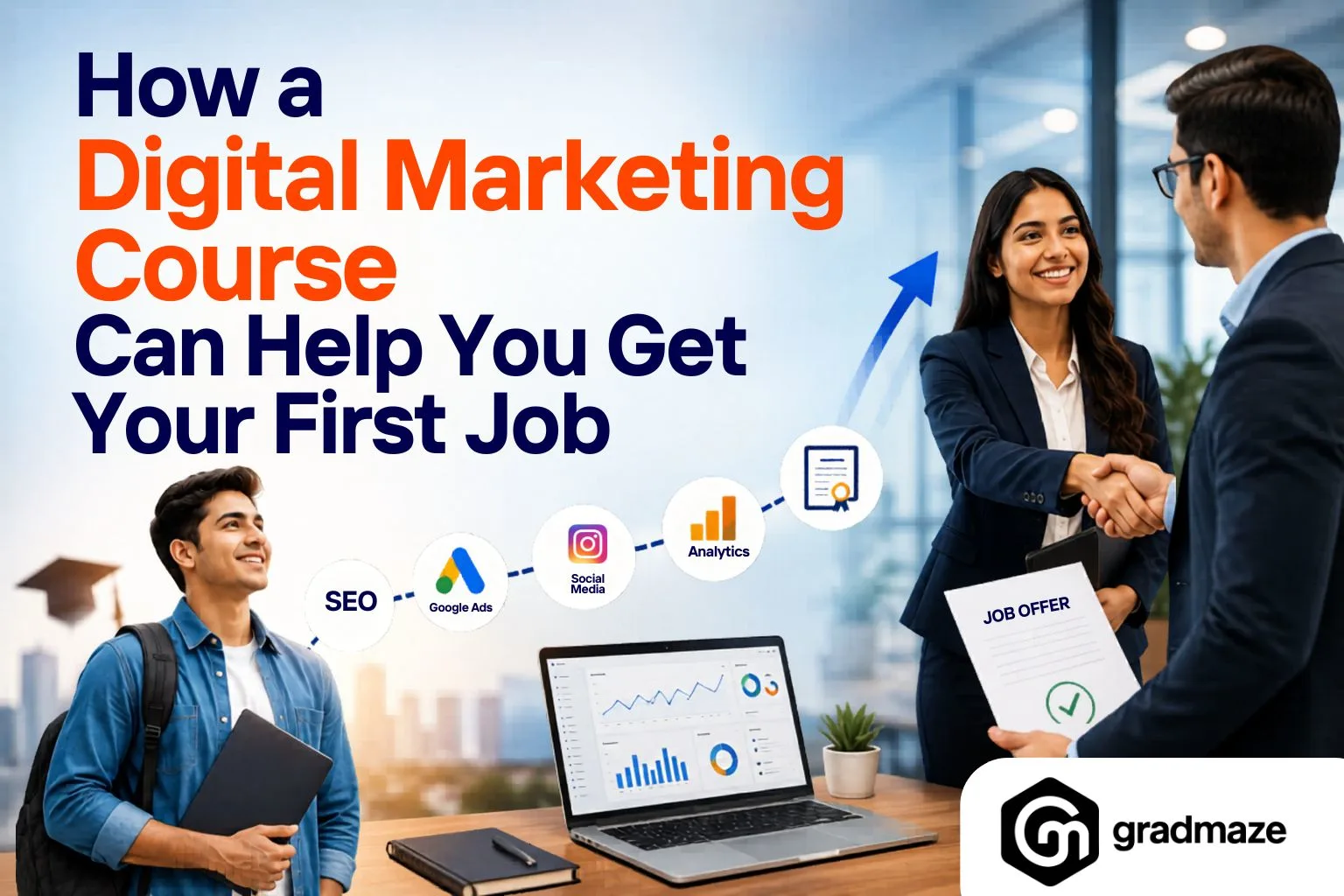
Short answer – yes, a digital marketing course can directly help you land your first job. It gives you practical skills you can show on day one, a portfolio built from real project work, industry-recognised certifications that make your resume stand out, and internship exposure that replaces the experience you do not have yet. By the time you finish, you are not pitching yourself as a fresher who is “willing to learn,” you are walking in as someone who has already done the work.
You Start With Zero – And That Is Completely Fine
Most people who join a digital marketing course have no background in marketing at all. Arts graduates, commerce students, and engineers who do not want to code everyone lands here. And that is one of the most beautiful things about this field. Your academic background does not determine your success in this field.
When you first join a course, you are introduced to how the internet actually works as a business tool. You start understanding why some websites show up on the first page of Google while others are buried. You begin to see why certain Instagram ads follow you around and how brands decide who to show those ads to. What once seemed complicated and mysterious begins to make perfect sense.
This foundational understanding is what builds your confidence. Before you start working with industry tools, you develop a deeper understanding of how digital marketing drives business growth. This strategic mindset helps you approach campaigns with confidence and sets a strong foundation for your future career.
The Course Puts Real Work in Your Hands
Here is where things get serious. A good digital marketing course does not just teach you concepts; it makes you work. You do not just read about SEO; you actually do keyword research for a real website. You do not just learn about Google Ads; you set up a campaign and track what happens. You write actual content, plan actual social media calendars, and analyse actual data from tools like Google Analytics 4.
By the time you are halfway through the course, you have already done things that most freshers have never touched. And this is the part that changes everything, because now you have work to show.
A portfolio built during your course is your biggest asset when you walk into an interview. Hiring managers at agencies and startups do not just want to hear what you know. They want to see proof of your skills in action. When you can open your laptop and show a campaign you ran, a blog you optimized, or a social media strategy you built, the conversation changes completely.
Certifications Give You Proof on Paper
While you are building real skills through the course, you are also working toward certifications that the industry actually recognises. Google’s Digital Marketing certification, Meta Blueprint, and HubSpot’s Content Marketing certification are not just badges. They are proof that you have been trained to a standard that employers trust.
For a fresher, this matters more than most people realise. When a recruiter is looking at ten resumes, and yours has two or three recognised certifications alongside a portfolio, you do not look like a fresher anymore. You look like someone serious enough to go and get trained properly.
For freshers trying to figure out how to get a digital marketing job as a fresher, certifications are often what get you the first interview. The portfolio is what converts that interview into an offer.
The Internship Bridge – From Learning to Earning
Most structured digital marketing courses in India come with internship support or tie-ups with agencies and companies. This is not a bonus feature; it is one of the most important parts of the entire journey.
An internship, even a short one to two months, does something that no classroom can. It puts you inside a real working environment. You see how teams operate, how client briefs are handled, how campaigns are reviewed, and how decisions are made under pressure. You make mistakes in a safe environment and learn from them fast.
By the time your internship ends, you will have professional experience on your resume. You are no longer a fresher with no experience; you are someone with real, documented work history. And many internships in this space directly convert into full-time job offers, especially if you have shown that you can deliver results.
If you want to understand what skills employers are specifically looking for right now, this blog on Top Skills Required for Digital Marketing in 2026 breaks it down clearly, and it is worth reading before you step into any interview.
The Job Market Is Actively Looking for You
Here is some good news that not many freshers are aware of. According to a May 2026 report by TeamLease EdTech, fresher hiring intent in India’s marketing and advertising sector shot up to 62% in the first half of 2026, compared to just 11% in the same period last year. That is not a small jump. That is, companies across India are actively deciding that they want to hire and train fresh talent.
Brands are scaling their digital advertising spends, investing in performance marketing, social commerce, and AI-driven campaigns. They need people who understand these channels. And because this space is evolving so fast, many companies prefer trained freshers who are up to date over experienced people who are still using old methods.
People are hiring for jobs like Social Media Executive, SEO Analyst, Google Ads Executive, Content Strategist, and Campaign Analyst. These jobs are going to freshers who have the training. The salary for these jobs can be as low as ₹3 LPA or as high as ₹6 LPA. Performance marketing specialists are the ones who usually get a salary of ₹6 LPA because they are really good at what they do. Social Media Executive and Google Ads Executive jobs are also in demand, like Content Strategist and Campaign Analyst jobs.
If you live in South India and want to know where the jobs are, this blog about Top Digital Marketing Careers & Openings in Chennai and Bangalore is really helpful. It tells you which cities have jobs, which companies are hiring, and what kind of Digital Marketing Jobs are available now. You should save this blog before you start looking for a Digital Marketing Job.
What the Course Actually Does to You – Beyond the Curriculum
This part is harder to measure but arguably the most important. Going through a full digital marketing course changes how you think.
You start reading the news differently, and you notice how brands position themselves. You scroll through Instagram differently, you catch yourself analysing why a particular Reel was made and who it was made for. You start understanding that everything online is intentional, and you begin to think the same way.
This mindset shift is what separates people who “did a course” from people who are genuinely ready for the job. Employers pick up on it in interviews. It shows in how you talk about your project work. It reflects in the questions you ask. And it is something that only comes from spending time actually working through the material, not just watching it.
Knowing how to get a digital marketing job as a fresher is one thing; actually being that fresher who walks in prepared, with a portfolio, certifications, and a clear way of thinking about marketing problems, is another. That is what a good course builds.
Conclusion
The journey from “I have no idea where to start” to “I just got my first offer letter” is very real, and for a lot of people in India, a digital marketing course is the exact path that made it happen. It gives you the skills, the work to show, the certifications to back it up, and the internship experience to make you credible. More importantly, it gives you the clarity to walk into a room and talk about marketing like someone who actually understands it.
If you are a fresher thinking about whether a digital marketing course is worth it, it is. The job market is ready for you. The question is whether you are ready for the job market.
And if you are ready to take that first step and want to understand exactly how to get a digital marketing job as a fresher in India with the right support behind you reach out to the Gradmaze team. They will help you figure out the right course, the right timeline, and the best way forward for your specific goals.
Frequently Asked Questions
1. Can a digital marketing course help me get my first job?
Yes, a digital marketing course can significantly improve your chances of landing your first job. Unlike many traditional courses that focus primarily on theory, digital marketing training emphasizes practical skills such as SEO, social media marketing, content creation, Google Ads, and analytics. These are skills employers actively look for when hiring freshers. Most quality courses also include live projects, certifications, and internship opportunities, helping you build a portfolio that demonstrates your abilities. This practical experience can make you more competitive and job-ready, even without prior professional experience.
2. Do I need a marketing background to learn digital marketing?
No, you do not need a marketing background to start learning digital marketing. Students from commerce, arts, science, engineering, and other educational backgrounds successfully transition into digital marketing careers every year. Most beginner-friendly courses start with the fundamentals and gradually introduce advanced concepts. Since digital marketing relies more on creativity, analytical thinking, and continuous learning than formal qualifications, anyone with an interest in online business and marketing can build a successful career in this field regardless of their academic background.
3. What skills will I learn in a digital marketing course?
A comprehensive digital marketing course typically covers SEO, social media marketing, content marketing, email marketing, Google Ads, Meta Ads, website optimization, analytics, and marketing strategy. You will also learn how to use industry-standard tools such as Google Analytics, Google Search Console, keyword research platforms, and social media management tools. Beyond technical skills, courses often help students develop communication, problem-solving, data analysis, and campaign management abilities, all of which are valuable in modern marketing roles and can increase employability.
4. How long does it take to become job-ready in digital marketing?
The time required to become job-ready depends on the course structure and your commitment to learning. Most digital marketing courses range from three to six months and include practical assignments, projects, and assessments. Students who actively participate in projects and internships can often become ready for entry-level roles within this period. Consistent practice and staying updated with industry trends further accelerate learning. Many freshers begin applying for internships and junior marketing roles even before completing their training.
5. Are digital marketing certifications important for freshers?
Yes, certifications can be extremely valuable for freshers. Certifications from recognized platforms such as Google, Meta, and HubSpot demonstrate that you have acquired industry-relevant knowledge and skills. They also add credibility to your resume, making it easier for recruiters to shortlist your profile. While certifications alone may not guarantee a job, they complement practical experience and project work. When combined with a strong portfolio, certifications can significantly improve your chances of securing interviews and employment opportunities.
6. What are the best entry-level jobs after completing a digital marketing course?
Freshers who complete a digital marketing course can apply for roles such as Digital Marketing Executive, SEO Analyst, Social Media Executive, Content Marketing Executive, PPC Executive, Email Marketing Executive, and Marketing Coordinator. These positions provide exposure to various digital channels and allow professionals to build specialized expertise over time. As experience grows, individuals can progress into advanced roles such as Digital Marketing Manager, Performance Marketer, Content Strategist, or Marketing Consultant, creating long-term career growth opportunities.
7. Is an internship necessary after a digital marketing course?
While not mandatory, an internship is highly recommended because it bridges the gap between learning and professional work. Internships provide hands-on experience with real campaigns, clients, deadlines, and business objectives. They help students apply theoretical concepts in practical situations while building confidence and industry exposure. Additionally, many companies prefer candidates with internship experience because they require less training after hiring. In some cases, internships can even lead directly to full-time job offers based on performance.
8. What salary can a fresher expect in digital marketing?
The salary for freshers in digital marketing varies based on skills, certifications, location, and company size. Entry-level professionals typically earn between ₹3 LPA and ₹6 LPA in India. Candidates with strong portfolios, internship experience, and expertise in high-demand areas such as SEO, performance marketing, or analytics may receive higher starting packages. As professionals gain experience and specialize in specific domains, salary growth can be substantial, making digital marketing an attractive career option for fresh graduates.
9. Is digital marketing a good career choice in 2026 and beyond?
Digital marketing continues to be one of the fastest-growing career fields as businesses increasingly invest in online channels to reach customers. Companies across industries require professionals who can manage websites, social media platforms, search engine optimization, paid advertising, and content strategies. The rise of AI-powered marketing, e-commerce, and data-driven decision-making is creating even more opportunities for skilled professionals. As a result, digital marketing remains a promising career path with strong demand and long-term growth potential.
10. How can I stand out as a fresher applying for digital marketing jobs?
Freshers can stand out by focusing on practical skills rather than relying solely on academic qualifications. Building a portfolio that showcases projects, campaign results, content samples, or SEO work demonstrates real-world capabilities to employers. Earning recognized certifications, completing internships, staying updated on industry trends, and developing strong communication skills can further strengthen your profile. Recruiters often prefer candidates who can showcase practical experience and a willingness to learn over those who only possess theoretical knowledge.