
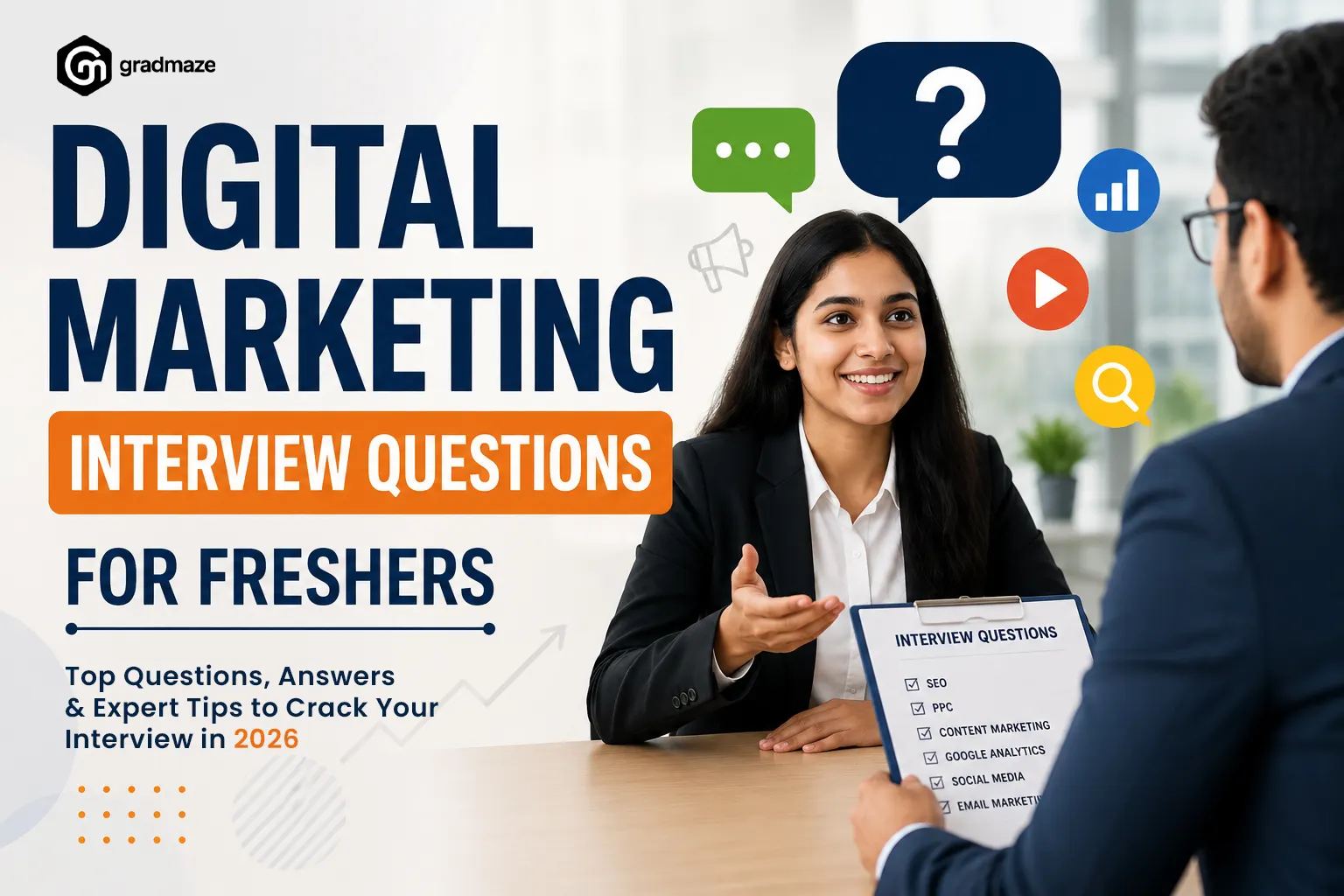
Most Digital Marketing Interview Questions for freshers focus on SEO, SEM, PPC, Google Analytics 4 (GA4), content marketing, social media, email marketing, and keywords. Interviewers look for clear communication, basic tool knowledge, practical thinking, and an understanding of current digital marketing trends rather than prior work experience.
So you finally decided to get into digital marketing. Good choice, honestly. But here’s where most freshers get stuck: they know the subject, they’ve watched the YouTube videos, maybe even done a course or two. And then they sit in front of an interviewer and go completely blank.
That’s what this blog is about. We’re going to walk through the digital marketing interview questions that come up again and again for freshers, how to actually answer them without sounding like you copied from a textbook, which tools you should know before you step in, and a few things that can quietly make or break your interview. If you’re a BBA student, an engineering graduate, or even someone from an arts background who’s pivoting into marketing, keep reading.
Why So Many Freshers Are Chasing Digital Marketing Jobs Right Now
Walk into any college placement session in Tamil Nadu or Karnataka, and you’ll notice that digital marketing roles are filling up fast. India is on track to add over 2 million digital marketing jobs by 2026, and companies of all sizes, from local startups in Madurai to large firms in Hyderabad, are genuinely struggling to find good people.
Here’s the thing that most people don’t tell you, though: the barrier to entry is lower than most careers. You don’t need a specific degree. You don’t need coding skills. What you need is a clear head, some practical exposure, and the ability to talk about what you know without fumbling. Interviews for fresher roles are more about your thinking than your experience.
What the Interviewer Is Actually Trying to Figure Out
Most freshers prepare by memorizing definitions. That’s fine as a starting point, but it’s not enough. Interviewers in 2026 want to know if you can apply what you know. Can you look at a problem and think through it? Do you understand why something works, not just what it is?
The moment you start giving robotic textbook answers, you lose them. The candidates who get hired are the ones who explain things as they’ve actually thought about them, not like they’re reading from a screen.
The Most Common Digital Marketing Interview Questions for Freshers
1. What is digital marketing?
Don’t say “promoting products online.” Every candidate says that, and it means nothing. Talk about it like this: digital marketing is how a business finds its customers where they already spend their time. On Google, on Instagram, in their inbox, on YouTube. It’s trackable, affordable, and gives you actual data on what’s working and what isn’t. That’s what makes it different from putting up a banner on a street corner.
2. What is the difference between SEO and SEM?
SEO is the work you do so that Google starts showing your website to people without you paying for it. It takes time, sometimes months, but once it works, it keeps working. SEM is when you pay Google to put your website at the top right away. You stop paying, you stop showing up. Both are useful, but for different situations. A new business that needs leads quickly will lean on SEM. A business playing the long game will invest in SEO. A smart marketer uses both.
3. What is a sales funnel?
Think of it this way. Not everyone who sees your brand is ready to buy immediately. Some people are just discovering you. Some are thinking about it. Some are almost ready. A sales funnel is how you talk to each of these people differently based on where they are in that journey. Awareness, Interest, Decision, Action, those are the four stages. Your job as a marketer is to move people from one stage to the next using the right content, the right ad, or the right email at the right moment.
4. What is Google Analytics and why does it matter?
Google Analytics tells you the story of what’s happening on your website. Who’s visiting, where they came from, how long they stayed, what pages they read, and whether they did what you wanted them to do. The current version is GA4, and it works differently from the old one; it tracks user actions as events rather than just page views. As a fresher, you should at least know what sessions, bounce rate, and conversion rate mean. These three will come up constantly.
5. What are keywords, and how do you use them?
Keywords are what people type into Google when they want to find something. “Digital marketing course in Nagercoil” is a keyword. “Best laptop under 50000 in India” is a keyword. Your job is to figure out what your potential customers are searching for, and then make sure your content or your ads show up for those searches. Two terms worth knowing here, short-tail keywords are broad and competitive, like “digital marketing.” Long-tail keywords are more specific and easier to rank for, like “digital marketing course for freshers in Tamil Nadu.”
6. What is content marketing, and how is it different from advertising?
The advertisement says, “Buy this.” Content marketing says, “Let me help you first.” It’s the difference between a brand that keeps showing you the same pop-up ad and a brand whose blog actually taught you something useful. Content marketing works through trust. You give people valuable information through blogs, videos, or social posts, and over time, they start associating your brand with quality. Regular ads are useful for quick conversions, but content marketing is what builds a loyal audience.
7. What is PPC and how does it work?
Pay-Per-Click is what PPC stands for. When you make an ad, you have to bid on a keyword. You only pay when someone clicks on your ad. Google Ads is the place for this. The thing that matters here is Click-Through Rate, which is also called CTR. It shows you what percentage of people who saw your ad actually clicked on it.
When people ask you about Pay-Per-Click, they want to know if you really understand how it works, not just what the letters mean. They want to see if you get the idea behind bidding and how to measure if your ad is doing well.
8. Which social media platforms matter most in India and why?
The honest answer is that it depends on who the people are that you are trying to reach. Instagram and YouTube work best for most consumer brands because that’s where people spend the most time. LinkedIn is where B2B conversations happen; if you’re marketing to businesses or professionals, that’s your platform. Facebook still has a massive user base in smaller towns and Tier 2 cities across India. The key thing to mention in your interview is that each platform has its own content format and audience behaviour. A Reel strategy won’t work on LinkedIn, and a LinkedIn post won’t land on Instagram.
9. What is email marketing, and is it still relevant?
Yes, very much so. A lot of freshers assume email marketing is outdated because inboxes feel cluttered. But when it’s done right, with the right message going to the right person at the right time, email consistently gives better returns than most other channels. The concept that matters here is segmentation: dividing your email list into groups based on interests, behaviour, or where they are in the buying journey, and sending them something relevant. Tools like Mailchimp and HubSpot make this pretty manageable even without a big team.
10. How do you keep up with what’s changing in digital marketing?
This question is really asking, are you genuinely curious about this field, or are you just here for a job? Don’t say “I scroll through Instagram.” Be specific. Say you follow Search Engine Journal or Neil Patel’s blog. Mention that you check Google’s Search Central for algorithm updates. Talk about free courses on Google Skillshop or HubSpot Academy. If you’ve done even one certification, bring it up here. It shows initiative, and interviewers notice that.
Tools You Should Be Familiar With Before the Interview
You do not need to be an expert. You should at least have opened and explored these tools: Google Analytics 4 for website analytics, Google Search Console for Search Engine Optimization insights, SEMrush or Ahrefs for keyword research, Canva for creating content, and Mailchimp for email campaigns. You should have looked at Google Analytics 4 for website analytics and Google Search Console for Search Engine Optimization insights. You should also have tried SEMrush or Ahrefs for keyword research, Canva for creating content, and Mailchimp for email campaigns. If you’ve used even one or two of these for a personal project or college assignment, mention it. Hands-on experience, even on a small scale, carries more weight than just knowing the name of the tool.
If you want to get properly trained on all of these before your interviews, the Digital Marketing Course at Gradmaze covers both the theory and real tool practice in a structured way that’s built specifically for freshers.
A Few Things That Can Quietly Make or Break Your Interview
Never put a tool on your resume that you’ve never actually used. Interviewers ask follow-up questions, and it falls apart quickly. Practice saying your answers out loud. It sounds obvious, but most people only rehearse in their heads and then freeze up when they have to actually speak. If you’ve managed a college fest’s Instagram page or run a small personal blog, bring that up. It shows you’ve done something, even if it was small. And before you go in, spend 20 minutes on the company’s website and social pages, walk in with one genuine observation or idea. That alone can set you apart.
Conclusion
Getting ready for digital marketing interview questions is less about cramming and more about understanding. Know your basics well, be honest about what you’ve actually done, and show the interviewer that you’re genuinely interested in learning. That’s what gets freshers hired.
If you’d like some guidance on where to start or how to build the right foundation before your interviews, the Gradmaze team is happy to help. Just head over to our Contact page and drop us a message; we’ll help you find the right direction. Digital marketing has real opportunities waiting. With the right preparation, your first interview might go better than you expect.
Frequently Asked Questions
1. What are the most common digital marketing interview questions for freshers?
Freshers are usually asked about the basics of digital marketing, SEO, SEM, PPC, Google Analytics 4 (GA4), content marketing, email marketing, social media marketing, keywords, and sales funnels. Interviewers may also ask behavioural questions to understand your problem-solving ability, communication skills, and willingness to learn. Preparing practical examples and understanding how different digital marketing channels work together can help you answer these questions confidently.
2. How can I prepare for my first digital marketing interview?
Start by learning the fundamentals of digital marketing and practising common interview questions. Gain hands-on experience with tools like Google Analytics 4, Google Search Console, Canva, and Mailchimp. Read industry blogs, complete free certifications, and stay updated with AI-driven marketing trends. Practising your answers aloud and explaining concepts in simple language will improve your confidence during the interview.
3. Do I need certifications to get a digital marketing job as a fresher?
Certifications are not always mandatory, but they strengthen your profile and demonstrate your commitment to learning. Recruiters appreciate candidates who have completed certifications from trusted platforms such as Google Skillshop, HubSpot Academy, or Meta Blueprint. However, practical knowledge, internship experience, and the ability to explain marketing concepts clearly often have a greater impact than certificates alone.
4. Which digital marketing tools should every fresher know?
Freshers should have basic knowledge of Google Analytics 4 (GA4), Google Search Console, Canva, Mailchimp, and SEO tools like SEMrush or Ahrefs. Understanding how these tools are used for website analysis, keyword research, content creation, and email campaigns shows interviewers that you are ready to work in a real-world digital marketing environment.
5. What is the difference between SEO and SEM in an interview?
SEO focuses on improving a website’s visibility in organic search results through content optimisation and technical improvements. SEM uses paid advertising, such as Google Ads, to appear at the top of search results quickly. Interviewers expect freshers to explain that SEO is a long-term strategy, while SEM delivers faster results through paid campaigns. Both approaches help businesses increase online visibility.
6. Can a non-technical student build a career in digital marketing?
Yes. Students from commerce, arts, science, engineering, or management backgrounds can build successful careers in digital marketing. Most roles require creativity, analytical thinking, communication skills, and a willingness to learn rather than coding knowledge. With proper training, practical projects, and continuous learning, non-technical graduates can secure entry-level digital marketing positions across various industries.
7. What skills do interviewers look for in digital marketing freshers?
Recruiters look for candidates who understand digital marketing concepts, communicate confidently, think analytically, and demonstrate curiosity about industry trends. They also value basic knowledge of SEO, paid advertising, social media, content marketing, analytics, and AI tools. Showing practical experience through internships, personal projects, or college campaigns can make your profile stand out from other freshers.
8. Is Google Analytics 4 important for digital marketing interviews?
Yes. Google Analytics 4 (GA4) has become one of the most important analytics platforms used by businesses. Freshers should understand basic concepts such as users, sessions, events, engagement rate, and conversions. Knowing how GA4 helps businesses measure website performance and user behaviour can leave a positive impression during interviews and improve your chances of getting shortlisted.
9. How should I answer behavioural questions during a digital marketing interview?
Behavioral questions assess your attitude, teamwork, adaptability, and problem-solving skills. Use the STAR method (Situation, Task, Action, Result) to structure your answers with real examples from college projects, internships, or personal experiences. Speak honestly, focus on what you learned, and explain how your experience prepared you for a career in digital marketing.
10. Are digital marketing jobs in demand for freshers in India?
Yes. Digital marketing continues to be one of the fastest-growing career fields in India as businesses increase their online presence. Companies across industries are hiring freshers for roles in SEO, social media marketing, content marketing, paid advertising, analytics, and email marketing. Candidates with practical skills, certifications, and hands-on project experience have better opportunities to secure entry-level positions and build long-term careers.